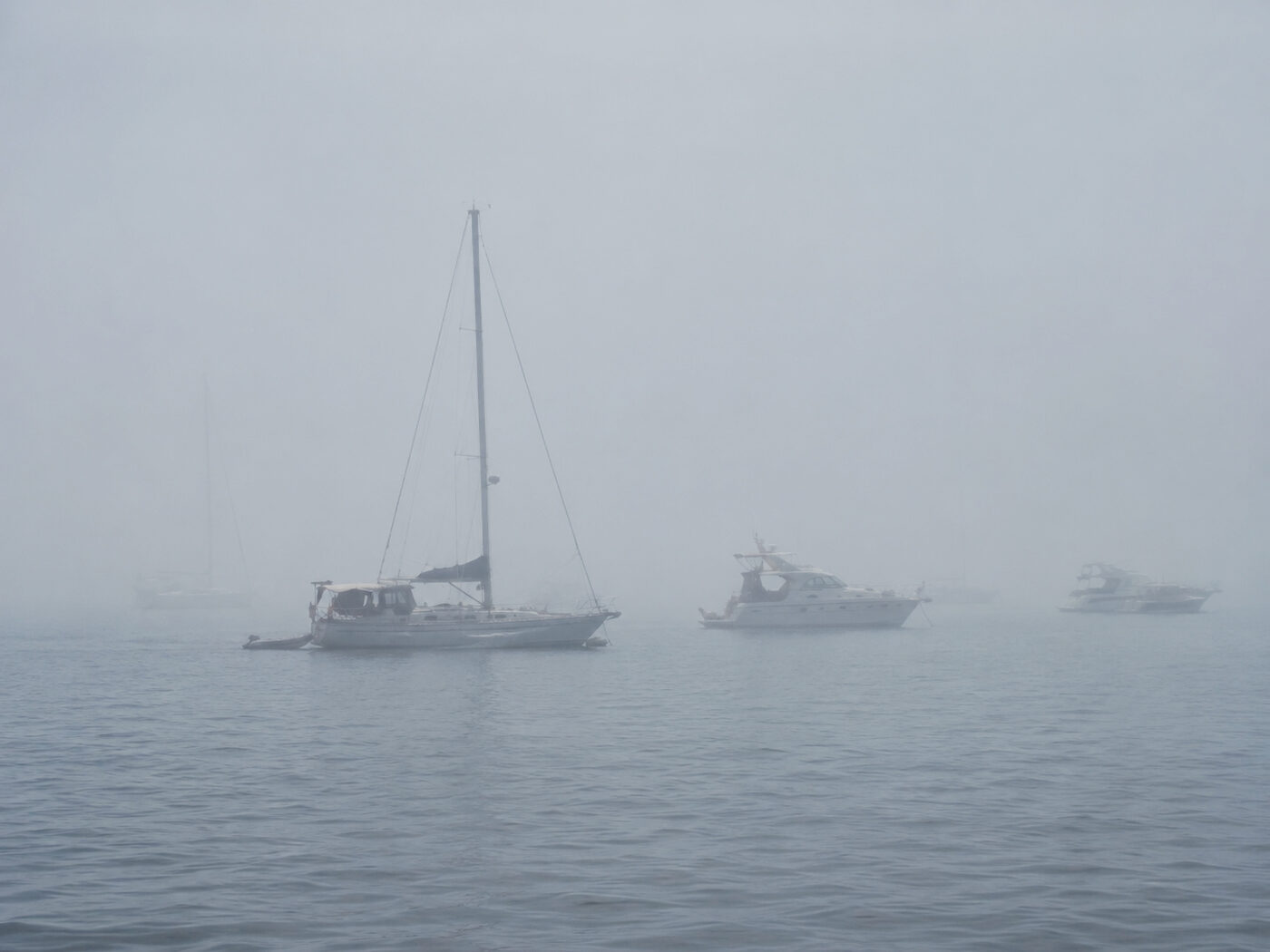
Fog does not approach so much as arrive. One minute the horizon is there; two minutes later the bow is a gray suggestion and sound comes from everywhere and nowhere. Most skippers reach for the chartplotter, see their own boat sitting reassuringly on the map, and relax. That is exactly the trap.
A well-documented case from the UK Marine Accident Investigation Branch makes the point. A yacht — well equipped, with a radar screen in the cockpit and another at the chart table, and a crew of five — collided in fog with a far larger vessel. The MAIB found the skipper had misunderstood which collision rules apply in restricted visibility, could not use the radar effectively, was over-reliant on the bigger ship's automatic plotting, and had the radar set in the wrong stabilization mode for collision avoidance. The kit was excellent. The collision still happened.
Why the GPS won't save you
A chartplotter answers one question — where am I? — beautifully. It does not answer the only question that matters in fog: is anything about to hit me, and what do I do about it? GPS shows your position relative to the seabed. It tells you nothing about the trawler crossing ahead or the ship overtaking from astern. For that you need radar used properly, your ears, and the rule written for exactly this situation.
Rule 19 is the rule that does save you
In clear weather, vessels see each other and there is a give-way vessel and a stand-on vessel. In restricted visibility, that disappears. Under COLREG Rule 19 there is no stand-on vessel — every vessel proceeds with caution, and the normal in-sight signals do not apply.
And do not forget your voice: in or near restricted visibility a power-driven vessel underway sounds one prolonged blast every two minutes; sailing and other vessels sound one prolonged followed by two short — the signals of Rule 35. They are how you are found by ears when you cannot be seen.
Navigation Lights & Signals Checklist
35 cited checks across lights, day shapes, sound and distress signals — keep it aboard. Enter your email and we'll send the PDF.
Use the radar — or don't trust it
- Plot, don't dodge. Picking targets to "go around" without systematic observation is how radar-assisted collisions happen. Determine CPA and whether risk exists.
- Right mode. For collision avoidance, sea-stabilized, not ground-stabilized — the error flagged in the MAIB report.
- Small craft vanish. Yachts and wooden boats may give little or no return. A fog signal may be your only warning. AIS is a supplement, not a guarantee.
- Train before you need it. A radar you cannot read in anger is decoration. Practice in clear weather.
Keep clear water around you. A mile from a ship in fog is close enough. Slow down, listen, plot, and let Rule 19 — not your plotter — make the decisions.